
What Is GWP? How to Turn a Building Material's Carbon Footprint Into Something Customers Understand
By Curtis (RoomDreaming Editor)
GWP is the number behind a building material's carbon footprint, usually written as kg CO₂e per square meter. Customers don't connect with it because they don't know how many square meters their room is. Put the product into a photo of their room, estimate the area, and you can say: "This wood floor in your living room stores about 87 kg of carbon."
The carbon data already exists: carbon footprint labels, green building material labels, and EPDs.
The problem is that all of them say "so many kg CO₂e per square meter." Customers nod politely and go back to asking about color.
What's the difference between a carbon label, a green building label and an EPD?
There are three common kinds of "green" information, and they measure different things. The first two are Taiwanese schemes, which is where we work:
| Label | Issued by | What it measures |
|---|---|---|
| Carbon footprint label | Taiwan's Ministry of Environment | How much carbon the product emits from raw materials to manufacture |
| Green Building Material label | Taiwan's building research institute and Taiwan Architecture & Building Center | Ecological, healthy, recycled and high-performance categories — for example, formaldehyde emissions |
| EPD (Environmental Product Declaration) | International, third-party verified | GWP and other environmental data, with the life-cycle stages clearly stated |
Most markets have their own version of the first two. The EPD is the one international buyers and architects recognize everywhere.
What is GWP, and how do you read it?
GWP (global warming potential) converts carbon dioxide, methane and other greenhouse gases into "the equivalent kilograms of carbon dioxide," written as CO₂e.
If a product says "GWP: 5 kg CO₂e/m²," each square meter corresponds to about 5 kg of carbon dioxide emissions. Lower is better; a negative number means the product stores carbon.
Always ask one question: "Calculated up to where?" A figure that stops at the factory gate can be very different from one that runs to end of life. To compare two products, the scope has to match.
Why is a wood floor's carbon footprint negative?
People are often surprised that a wood floor can have a negative footprint.
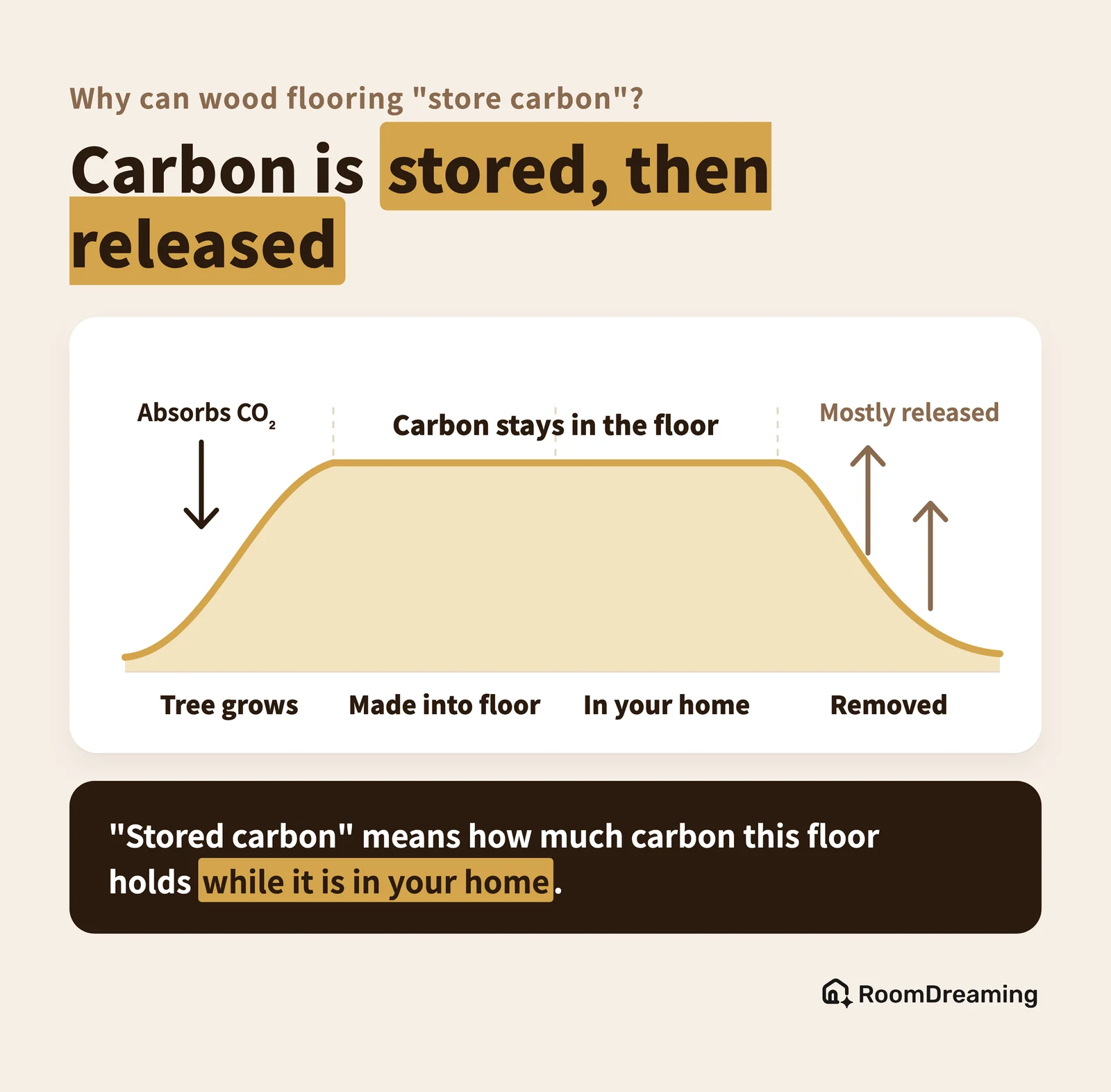
As trees grow, they take carbon dioxide out of the air and store the carbon in the wood. That carbon is still there after the wood becomes a floor, so the cradle-to-gate figure often comes out negative.
But say it carefully:
- Accurate: this floor stores this much carbon while it's in use.
- Overstated: installing this floor removes this much carbon from the planet.
When the floor is eventually burned or landfilled, most of that carbon goes back into the air. Say it accurately and customers trust you more for it; overstate it and it becomes greenwashing.
Do customers care about health or carbon?
Honestly, most homeowners ask about health first: formaldehyde, smell. Few volunteer "what's the carbon footprint?"
The two don't conflict, but keep them apart:
- Health: whether the material releases harmful substances — formaldehyde and VOC test results, health-related green labels.
- Carbon: the greenhouse gases tied to making the material — carbon footprint labels and EPDs.
Answer the health question first, then add: "This floor also has carbon data — want to see roughly how much carbon it stores in your room?" Carbon becomes a bonus, not a burden.
How do you make a carbon footprint instantly clear?
The formula is simple: floor area × carbon footprint per m² = the carbon in this floor.
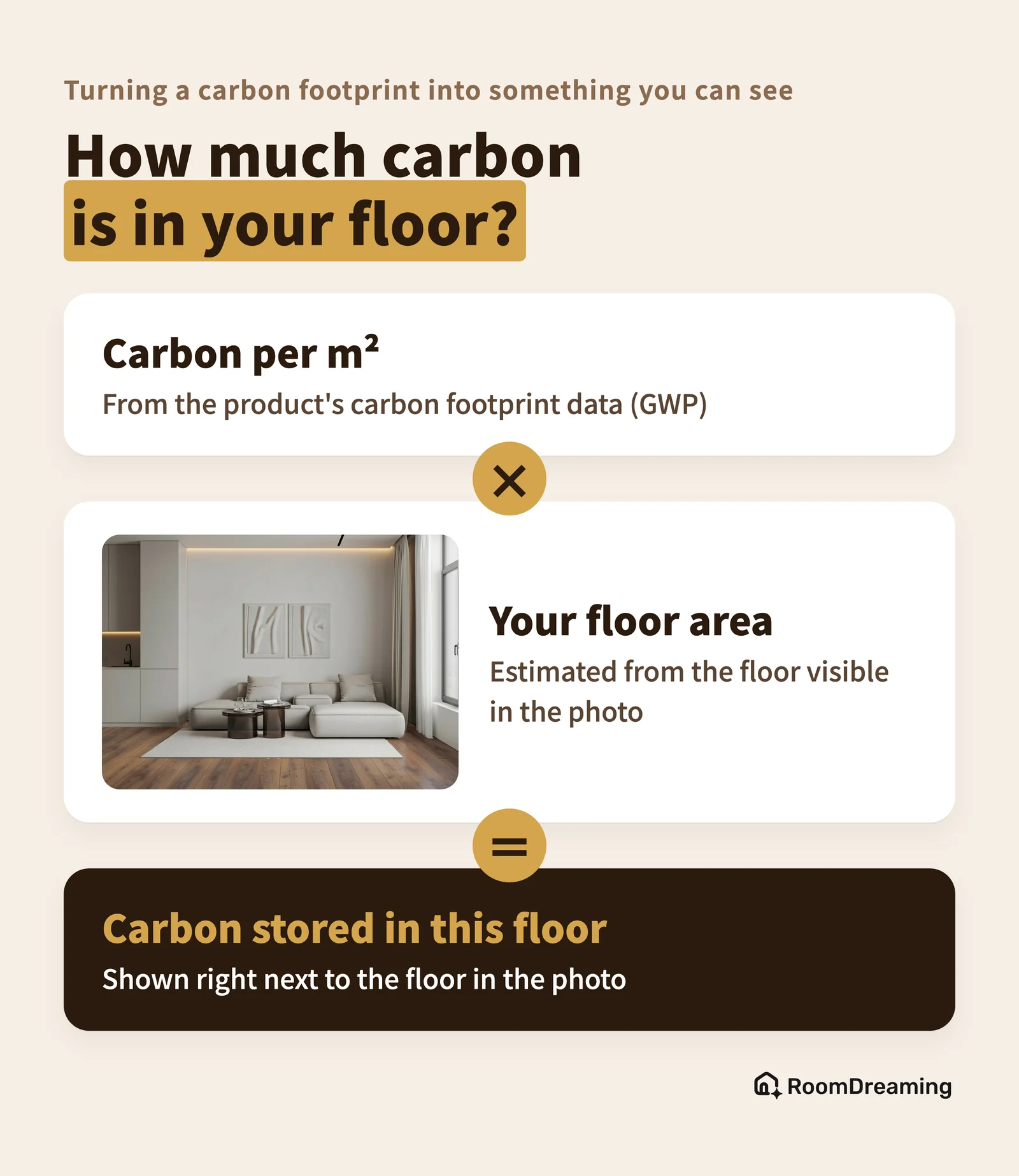
The hard part was never the multiplication. It's knowing how big the customer's room is. That used to mean measuring or reading plans; now it can be estimated from a photo. Put the wood floor into the customer's room photo, and the system estimates the visible floor area and multiplies it by the product's carbon data.
"Minus so many kilograms per square meter" means nothing to a customer. "The floor in your living room stores 87 kg of carbon, about what 7 trees absorb in a year" lands immediately. The panel also shows how much the same area of SPC (stone-plastic composite) or LVT (luxury vinyl tile) flooring would emit, so the difference is obvious at a glance.
It's an estimate — floor hidden behind furniture isn't counted — so use it to compare and to make the number tangible, not for reporting.
On October 17, at the 2026 Grand Health Forum co-hosted by the Taiwan Advanced Democracy Association and CommonHealth, the booth run by interior design firm Vyee Design and RoomDreaming will demonstrate this live with German wood flooring from Taige. Event details are in AI makes materials visible: the healthy-home AI material experience.
If you're a building-material brand, all you need to supply is the product's carbon data (an EPD or carbon label, ideally per square meter). Products with data show the estimate in the material visualizer; products without it look exactly as before.
FAQ
What is GWP?
GWP (global warming potential) converts different greenhouse gases into the equivalent kilograms of carbon dioxide. For building materials it's usually written as kg CO₂e per square meter — the lower the number, the lower the emissions attributed to that product.
Do wood floors really store carbon?
Yes, if you say it correctly. Trees absorb carbon as they grow and it stays in the wood, so a wood floor's footprint is often negative — meaning "this floor stores this much carbon." When the floor is eventually burned or landfilled, most of that carbon is released again.
How accurate is a carbon figure calculated from a photo?
It's an estimate. The area comes from the floor visible in the photo, multiplied by the carbon data the brand supplies. It's good for comparing products and making the number tangible, not for certification or reporting.
Show customers the floor first, then the carbon
Customers still look at color and pattern first — see how to choose a wood floor color, or try the RoomDreaming flooring visualizer.
Try it on a photo of your own room
Upload a photo and swap in real products to see them in your space. No download, no sign-up.