
How Decorative Paint Brands Let Customers Try Colors Online: Website, Sales Links and QR Codes on Color Cards
By Curtis (RoomDreaming Editor)
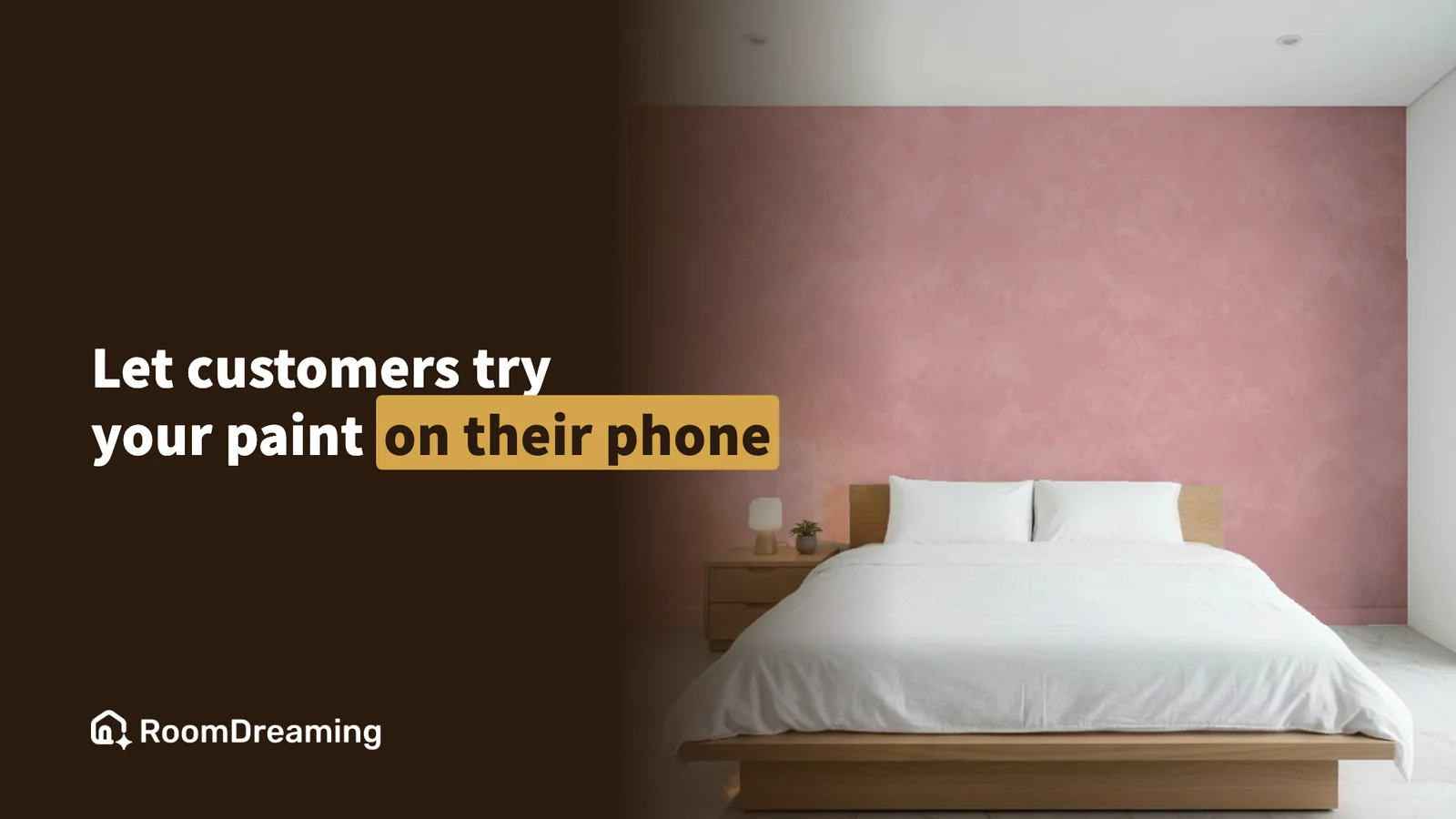
The most effective way for a decorative paint brand to let customers try colors online is to put a brand-owned paint visualizer in three places: your website, your sales reps' links, and a QR code next to the color card. Customers upload a photo of their own wall and switch one color between techniques and finishes — before anyone makes a sample board.
Decorative paint is hard to sell with words.
A client spends an afternoon in the showroom, touches the boards, takes a few color cards and says, "Let me talk it over at home." At home there's nothing to look at but small cards. They can't picture a whole wall, and the project quietly goes cold.
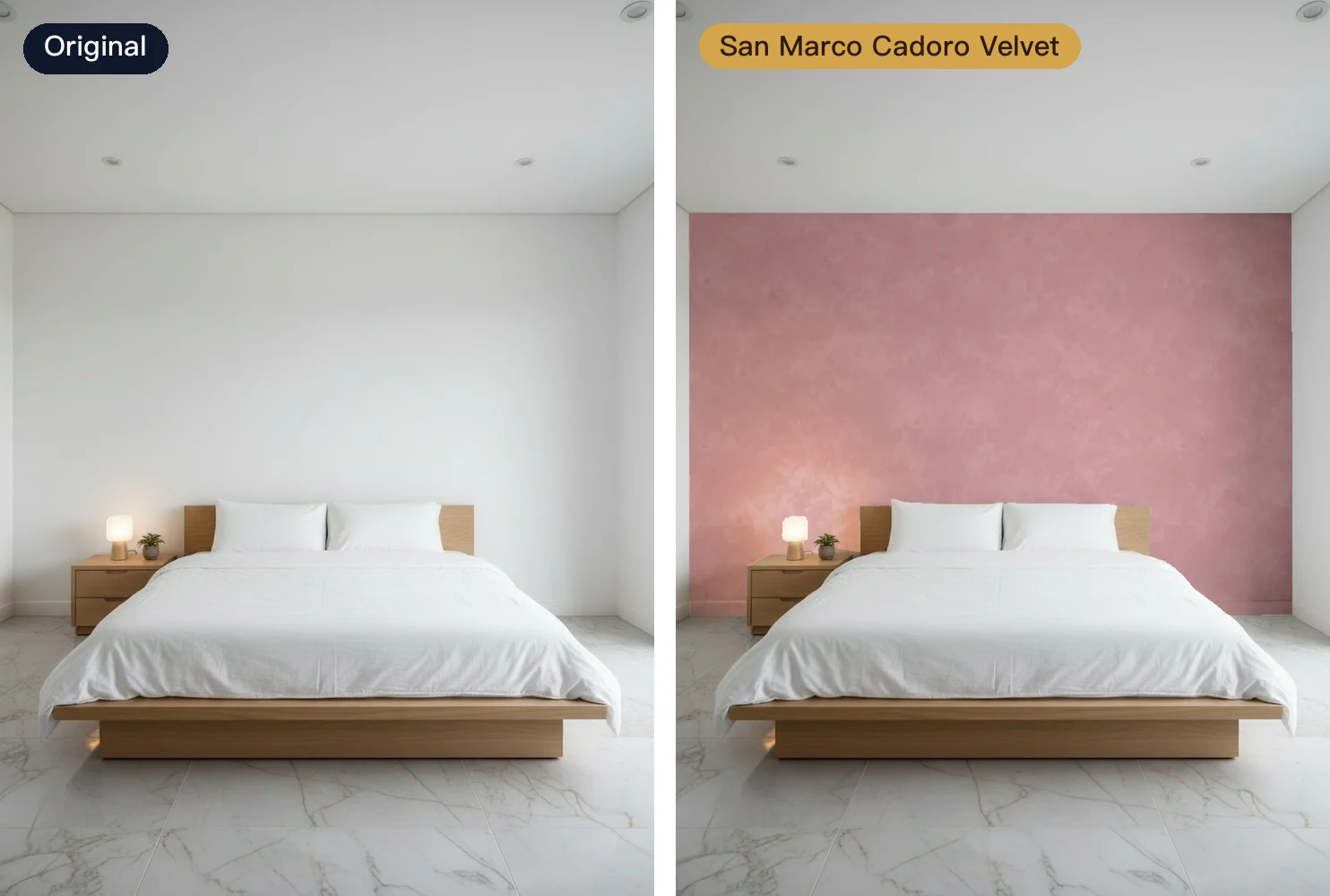
This is a bedroom headboard wall. On the right is Cadoro Velvet from San Marco, in the rose pink M620, applied with a blended trowel technique. With only a small pink swatch in hand, it's hard to picture a whole wall looking like this.
Where do decorative paint sales get stuck?
Usually in the stretch before the sample board. Three problems come up again and again:
- Sample boards are slow: mixing, applying and drying a board takes days. Every change of mind means another one.
- Color cards don't show technique or finish: a card prints a small patch of color. The same code troweled or brushed, in pearl or mineral matte, is a completely different wall.
- The lead goes cold at home: once the client leaves the showroom, they have nothing to keep exploring. By the time they come back to it, they may have seen something else elsewhere.
All three come from the same gap: customers can't see the paint on their own wall before they decide. For why the card isn't enough and where the sample board belongs, see why you can't choose decorative paint from a color card.
Where should the online color trial live?
One visualizer, placed at the three moments customers actually meet your brand:
| Where | Who uses it | When |
|---|---|---|
| Brand website | Homeowners and designers researching paint | While comparing brands and looking for ideas |
| Each rep's personal link | Designers and clients a rep is working with | Following up after a meeting |
| QR code on color cards and in the showroom | Anyone who took a card home or visited | At home, when they want another look |
All three open your own branded tool, with only your products in it. Brands such as LUXUS PAINT, San Marco, Atarashi and KEIM already run one on their Taiwan websites. The customer uploads a photo of their wall and starts switching colors and techniques — no app download, no sign-up.
The QR code on the color card is the most underrated of the three. It turns a card the customer takes home into something they can keep using. Instead of staring at a small swatch, they scan it and see that color on their own living-room wall.
When they like what they see, they can request a quote right there. In Taiwan, the message goes to the responsible rep through LINE — the messaging app most people and businesses there use — so the lead doesn't get lost.
What can customers see online?
An online trial for decorative paint can't just "change the wall color." Ordinary paint color tools are a flat overlay: one even block of color. With decorative paint, the texture and the finish are the product.
- One color, different techniques: LUXUS PAINT's TACTO, for example, can be applied four ways — skim, press, swirl and brush — and each one can be shown on the customer's wall.
- One color, different finishes: pearl sheen, metallic reflection and mineral matte, shown with AI photorealistic rendering.
- The scale of a full wall: the texture is laid out at the wall's real size, so it doesn't grow or shrink with how far away the photo was taken.
- The customer's own light: bright by the window, darker in the corners — the new wall follows the photo.
Same dining-room wall, same TACTO gray (Y-102), only the technique changed — skimmed on the left, swirled on the right:

Switch to a different product, and the mood of the room changes again. This living-room wall behind the sofa is in Homii suede paint from Atarashi, a gray-green H28, brushed on by hand in a cloud pattern:
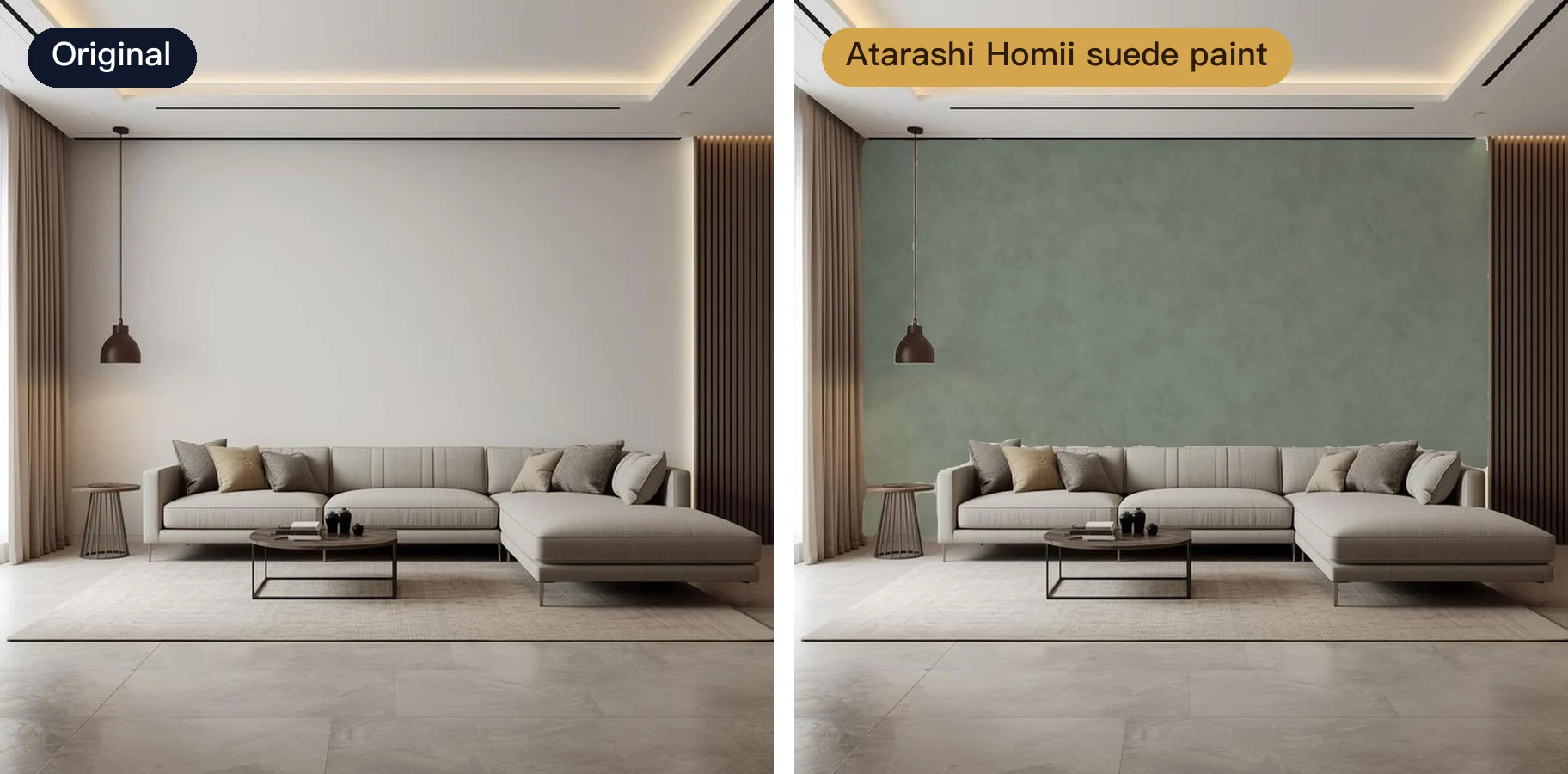
Customers filter out what they don't like on their phone and only take two or three options to sample boards. You still make boards — just closer to the sale.
What does onboarding involve, and how long does it take?
Decorative paint takes the most care of any material we onboard, because neither the color nor the texture can be wrong.
- Physical samples: color boards for the color range, plus a finished board for each technique.
- High-resolution scanning: we scan the texture and color of each board rather than reusing catalog photos.
- Color calibration: every scan is calibrated to the product's real color reference, so what customers see online can be trusted.
- Techniques and finishes: which techniques and finishes each color can switch between follows the brand's own product lineup.
Because every product is scanned and calibrated this way, onboarding a decorative paint brand takes over a month. In return, every customer and every rep sees the same calibrated catalog.
RoomDreaming holds 8,000+ building materials across art paint, wood flooring, tile and more — real products supplied by brands, not something AI sketched from a vibe. For the questions to ask when evaluating a tool like this, see what interactive tools a building-material website needs.
FAQ
How is a decorative paint visualizer different from an ordinary paint color tool?
An ordinary color tool turns the wall into one flat color. Decorative paint is about the texture the technique creates and finishes like pearl, metallic and mineral — that takes AI photorealistic rendering, and the same color has to be switchable between techniques.
How long does onboarding take?
Onboarding a decorative paint brand takes over a month. Every product is scanned from a physical sample board at high resolution and calibrated to the real color reference, so customers can trust the color they see online.
Do customers need to download an app?
No. They open the website entry point, the link a rep sent, or scan the QR code next to the color card, upload a photo of their wall and start trying colors — no download, no sign-up.
Let customers keep trying after they leave the showroom
See what an online color trial looks like in the RoomDreaming paint visualizer, or book a demo.
Try it on a photo of your own room
Upload a photo and swap in real products to see them in your space. No download, no sign-up.
Further reading
- Why You Can't Choose Decorative Paint From a Color Card: Sample Boards vs AI Paint Visualizer
- Should Your Building-Material Website Have a Visualizer? A 10-Point Checklist for Brands
- Interior Design Proposals Taking Too Long? How Designers Use Brands' AI Material Visualizers to Save Render and Selection Time