
Can ChatGPT or Gemini Pick Your Tiles? AI Room Design vs a Material Visualizer
By Curtis (RoomDreaming Editor)
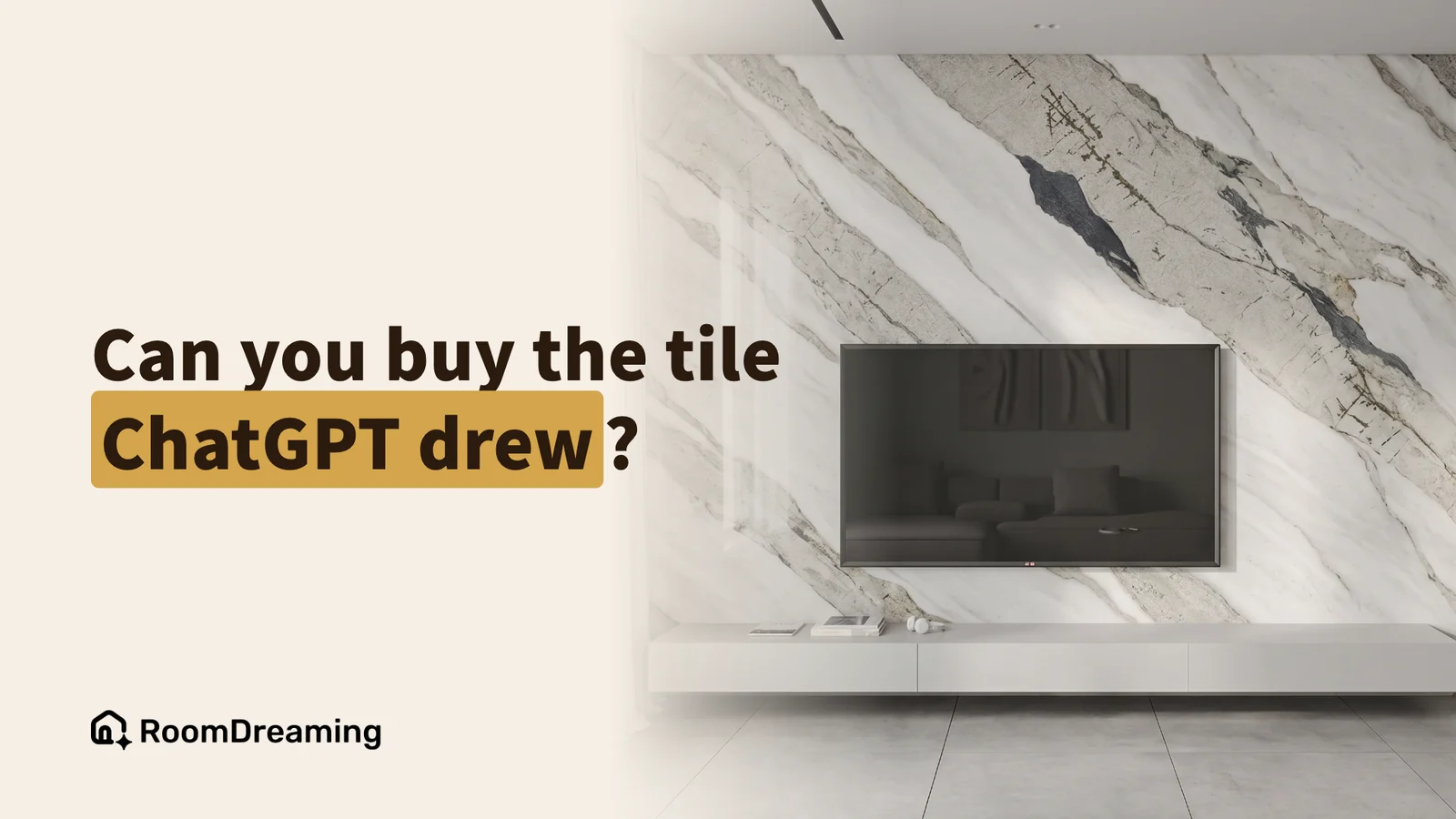
ChatGPT and Gemini are great for finding a renovation direction, but they don't have a building-material brand's real product data — what they draw looks similar, not necessarily the actual product. To see how a specific tile or paint will look in your own room, use the brand's AI material visualizer: it works from the real product's size, pattern and color reference.
More and more customers walk into showrooms holding an AI-generated living room and ask, "I want tiles that feel like this — do you have them?"
A customer who already knows the direction they want is good news. The problem is the next step: which product is that tile in the picture?
Where do ChatGPT and Gemini room images go wrong?
They are excellent for style. But for building materials, size, pattern and color are the product. Get them slightly wrong and it is a different product.
- Size doesn't match: ask for 60×120 cm tiles and you may get something closer to 50 cm — or one huge sheet.
- The pattern is the AI's own drawing: even with a product photo, it redraws the general feel rather than the tile's real pattern.
- It changes every time: run the same prompt twice and tile size and vein position can move.
- The whole image is redrawn: the TV or furniture may shift, and walls may change too.
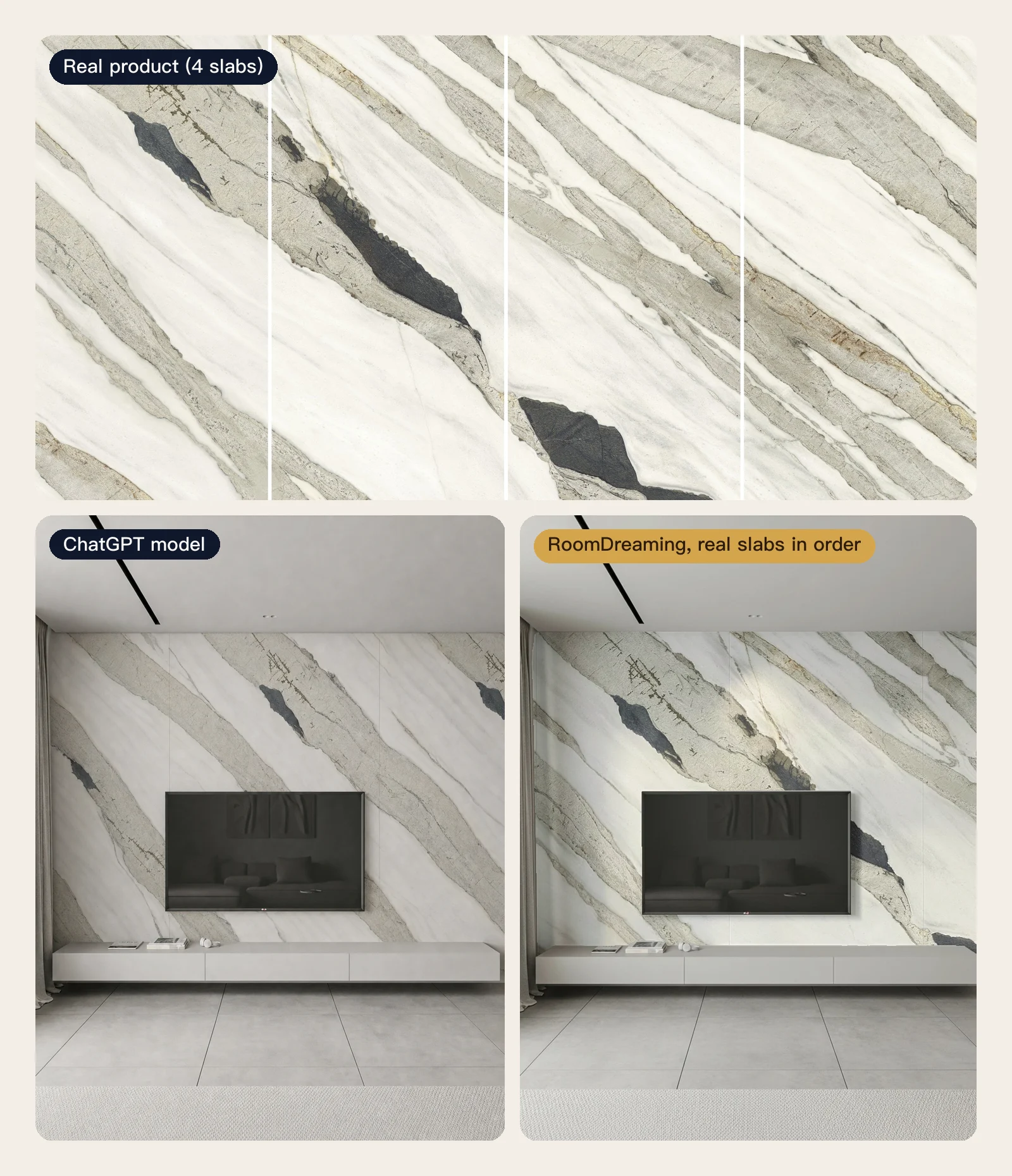
We gave the image model behind ChatGPT a photo of a 150×300 cm slab and a TV-wall photo, and asked it to put the slab on the wall. On top are the four real slabs this product ships as; below, the wall the AI drew on the left, and RoomDreaming laying those four real slabs in order on the right.
At a glance it looks close. Look again: the four real slabs are all different, with at most one dark inclusion each, always in a different place. The AI repeated the same dark patch several times and made the veining thinner and grayer. On the RoomDreaming wall, the position and width of the veins match the real slabs above.
A customer choosing from that image is picturing a wall that doesn't exist. They only find out when the slabs arrive and go up — when it's too late to change course.
Why not just give the AI a product photo?
One product photo is not one product. A photo doesn't tell the AI:
- how big the tile really is, and how many pieces fit on this wall;
- how many face variations the product has, and whether it ships random / mixed faces or numbered for vein matching (sequential layout);
- the paint's calibrated color reference, and whether it is matte, pearl or metallic.
Art paint is the same. Brands such as LUXUS PAINT offer one color in several application techniques, each with its own texture and sheen. AI can paint a beautiful wall, but it has no data on how one color looks in a different technique.
A customer brings an AI image. How should a rep respond?
- Treat the AI image as a direction: "You're after a light, large-format, fine-veined stone look — right?"
- Swap real products into the customer's own photo: pick two or three close matches and show them side by side.
- Finish with the physical sample: once it's down to one or two, confirm with a real sample.
There's no need to argue about whether the AI image is accurate. Just say, "Let me show you the ones we actually carry, in your own room" — and most customers are happy to keep talking.
The same flow works for interior designers. Use ChatGPT or Gemini to agree on a mood with the client, then switch to the brand's visualizer before anything goes into the specification, so the drawing and the order describe the same product.
How do the two work together?
| ChatGPT / Gemini | Brand AI material visualizer | |
|---|---|---|
| Best for | Finding a style; talking it over at home | Seeing a specific product in your room |
| Where products come from | Drawn by AI, or from an image you supply | Real products in the brand's catalog |
| Size and pattern | May change every time | Laid by the product data |
| Rest of the room | Redrawn; may change | Only the surface you chose changes |
| Afterwards | You search for the product yourself | Contact the brand or rep directly |
It isn't either-or: general AI finds the direction; an AI material visualizer confirms the product exists and really looks like this in your room. For more on what that kind of tool is, see what an AI material selection system is.
FAQ
Are ChatGPT or Gemini renovation images accurate?
They are very useful for finding a style direction, but tile size, pattern and paint color are not guaranteed to match any real product — and the same prompt run twice can give different results.
Can I give the AI a product photo and have it swap it in?
You can, but a single product photo doesn't contain the tile's real size, how many face variations the product has, or the paint's calibrated color. The AI redraws the feel of that photo, so the result looks similar but may not be that product.
I've already made images with ChatGPT. Do I still need a material visualizer?
Yes — they do different jobs. ChatGPT and Gemini help you find a direction; a brand's AI material visualizer confirms the product exists and shows how it really looks in your room.
See real products in your own photo
To see tile and paint laid into a room photo from real product data, take a look at the RoomDreaming tile visualizer and art-paint visualizer.
Try it on a photo of your own room
Upload a photo and swap in real products to see them in your space. No download, no sign-up.