
Tile and Material Selection Glossary: Face Variation, Vein Matching, Offset, Finish and AI Rendering
By Curtis (RoomDreaming Editor)

Most of the jargon you hear when choosing materials is about three things: how to preview the result, what a product actually is, and how it goes on the wall. This glossary explains the 12 terms that come up most, in a sentence or two each.
Walk into a tile showroom and the conversation can sound like another language: "this one has a lot of faces," "do you want an offset?", "it's a vein-matched series." Many people just nod along.
We've grouped the terms by what they're for. Jump to the one you need. (Our team works mostly with brands in Taiwan, where several of these terms come straight from the local tile trade.)
How do you preview the result?
Tile visualization (tile visualizer)
Tile visualization means placing a real tile or building material into a photo of the customer's own room, to see it installed before buying. In Taiwan the trade calls it "tao-tu"; most people search for a tile visualizer. A good one gets size, faces, grout and layout right; see What is a tile visualizer?.
AI photorealistic rendering
AI photorealistic rendering shows a swapped-in material together with the photo's light, reflections and shadows, so it looks genuinely installed. The alternative is a flat overlay, which pastes a picture of the material on the wall: right color, but flat. It's also different from AI image generators that redraw the whole picture; see Can ChatGPT or Gemini pick your tiles?.
AI material selection system
An AI material selection system is an online tool a building-material brand gives its customers, designers and sales reps: upload a room photo, pick real products from the brand's catalog, see them installed, then contact the brand or rep directly. RoomDreaming carries 8,000+ building materials across art paint, wood flooring, tile and more; the Taiwanese flooring company Crown Tai, for example, lets customers upload a photo and try its wood floors this way. More in What is an AI material selection system?.
What is the product, exactly?
Face variation
Face (or print) variation means the different pattern versions a factory produces for one tile design. Stone-look and wood-look tiles come with several faces so a wall doesn't repeat in neat rows; the sample in your hand is just one of them.
Color code
A color code is the number a brand gives each color, so the color ordered is the color installed. For paint, the code is how you match color — on KEIM's Taiwan website, for example, clicking a color code paints it straight onto the wall in your photo. For tile, also ask for one production batch per wall, since shades can vary between batches. For paint, see how paint brands let customers try colors online.
Surface finish (glossy / matte)
Finish is how a tile's surface looks and feels, most often glossy or matte. Glossy reflects light and wipes clean, so it's common on walls; matte doesn't glare and offers more grip, so it's common on floors. For bathrooms, see how to choose bathroom tile. Paint has a finish too: the same color applied with a different technique gives a different texture and sheen, and brands such as San Marco and LUXUS PAINT both offer metallic ranges.
Large format slab
A large format slab is an extra-large tile, often 120×240 cm (about 4×8 ft) or bigger, also sold as porcelain slab or sintered stone. Two or three cover a TV wall with few joints, but mistakes are expensive; see vein-matched large format tile.
How does it go on the wall?
Random shipping (mixed faces)
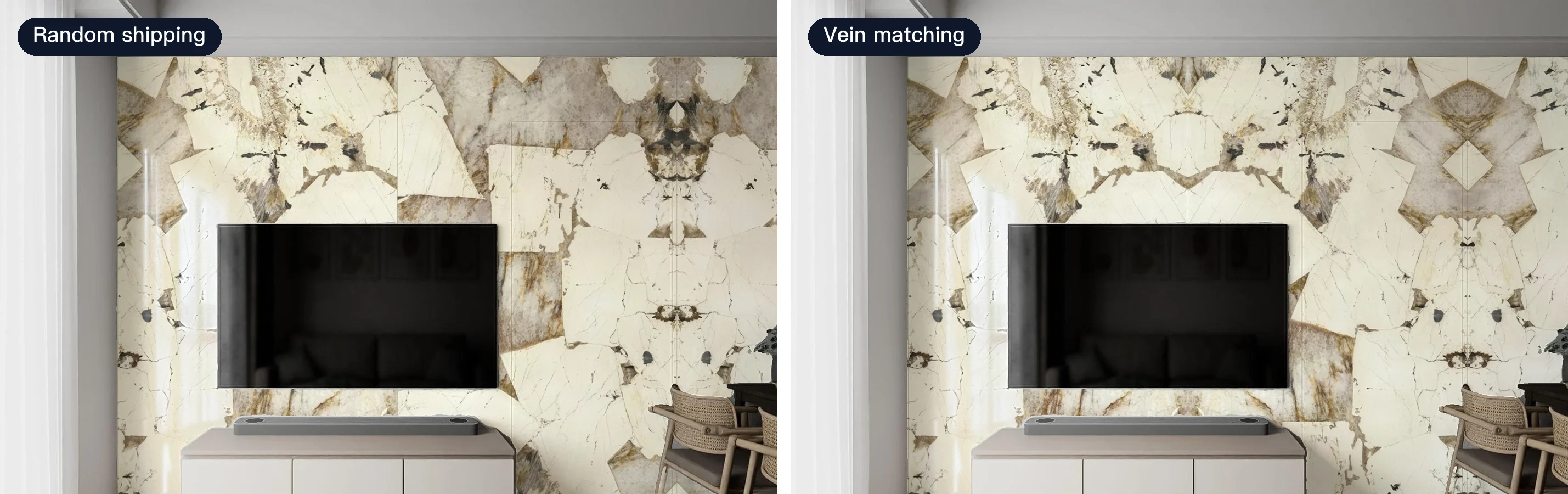
Random shipping means the different faces of one tile are mixed at random during installation, so the surface looks natural with no obvious repeats. It's the usual choice for floors and large walls.
Vein matching (sequential layout)
Vein matching means laying the tiles of one design in numbered order so the veining flows from one piece into the next, like a single block of stone. The installer doesn't flip anything on site; some slabs are designed as mirrored pairs, so laying them in order creates a symmetrical pattern.
Offset (1/2, 1/3)
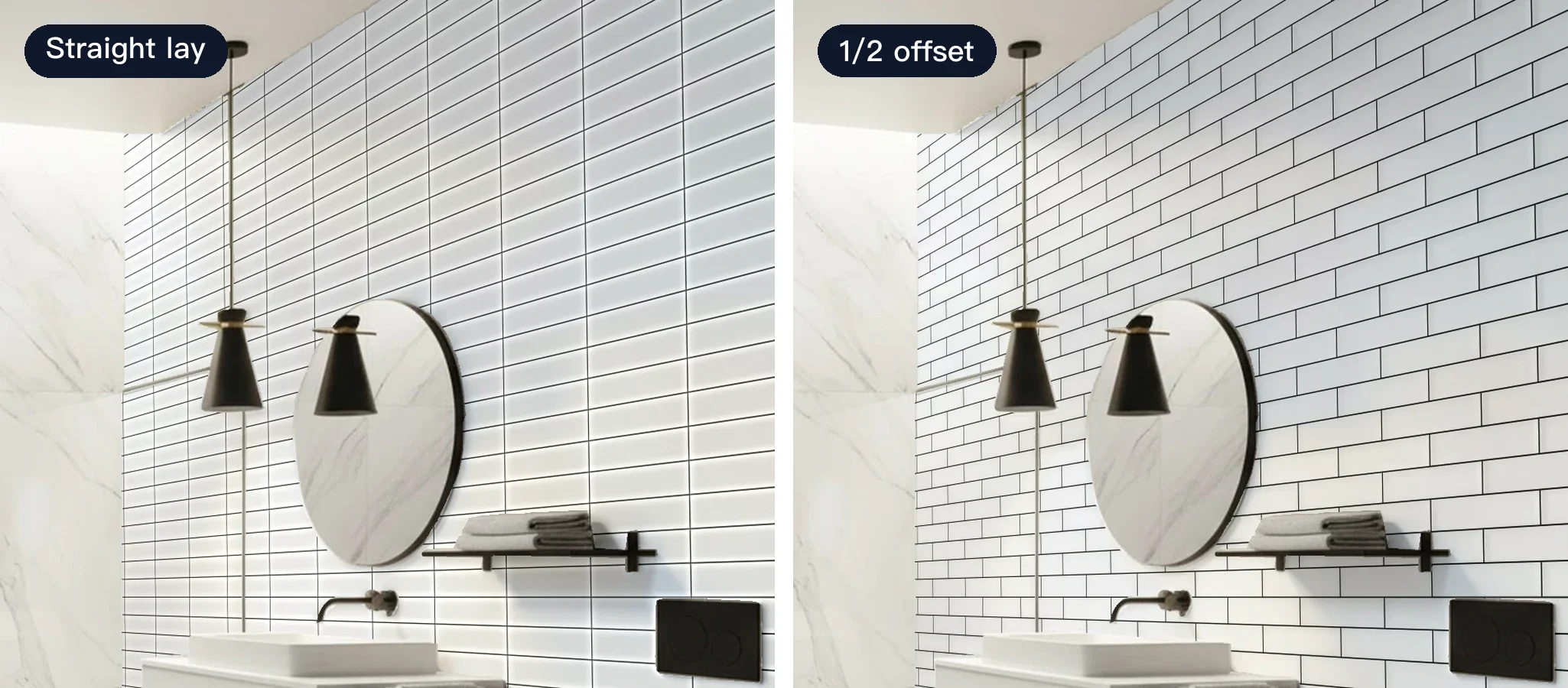
An offset layout shifts each row of tiles so the joints don't line up into a grid; it's also called a staggered or running bond pattern. A 1/2 offset shifts by half a tile, a 1/3 offset by a third. Long tiles are often slightly higher in the middle, which a 1/2 offset exaggerates, so a 1/3 offset is usually recommended. When all edges line up, it's a straight lay.
Herringbone and chevron
Herringbone lays rectangular tiles or planks at right angles to each other in a continuous zigzag; chevron cuts the plank ends at an angle so they meet in a sharp V along a straight center line. The two names get mixed up a lot, so confirm with a picture; see how to choose a wood floor color.
Grout
Grout is the joint between tiles and the material that fills it. It locks tiles in place, keeps water out and leaves room for expansion. Its color changes the look of a whole wall; see our grout color guide.
FAQ
Is vein matching the same as book matching?
Not quite. Vein matching (sequential layout) lays tiles in numbered order so the veining flows across them. Book matching mirrors two pieces like an open book; with porcelain slabs, some designs are printed as mirrored pairs, so laying them in order produces the symmetry.
What's the difference between a 1/2 and a 1/3 offset?
Each row is shifted by half a tile or a third of a tile. Long rectangular tiles are usually laid at a 1/3 offset, because a 1/2 offset makes any slight bow in the tile most visible.
How is tile visualization different from AI photorealistic rendering?
Tile visualization is the task: putting a product into a room photo to see it installed. AI photorealistic rendering is how it's made believable: the material picks up the photo's light, reflections and shadows.
Now try it on a photo
Switching these options once on a photo makes them clearer than any definition. Try the RoomDreaming tile visualizer to swap tiles, grout colors and layouts on a photo of your own room.
Try it on a photo of your own room
Upload a photo and swap in real products to see them in your space. No download, no sign-up.